
Table Of Contents
For a long time, robots have been most comfortable in places where everything is planned down to the smallest detail-think factory floors and assembly lines. Outside those tightly controlled spaces, things get messy fast. Humans move unpredictably, objects vary in shape and texture, and instructions are rarely precise.
That’s the challenge Microsoft is tackling with Rho-alpha, a new robotics system designed to help machines operate more naturally in the real world.
Often referred to as the Rho-alpha Robotics Model, this new system is part of Microsoft’s broader push into Physical AI, where intelligent software doesn’t just think or see, but actually interacts with the physical environment.
Turning simple words into real-world actions
At its core, Rho-alpha is designed to understand everyday human language and translate it directly into physical movement, allowing robots to respond naturally to spoken or written instructions.
Rather than relying on complex, step-by-step programming, users can issue clear commands such as “Push the green button,” “Pull out the red wire,” or “Turn the knob to position five,” making human-robot interaction far more intuitive.
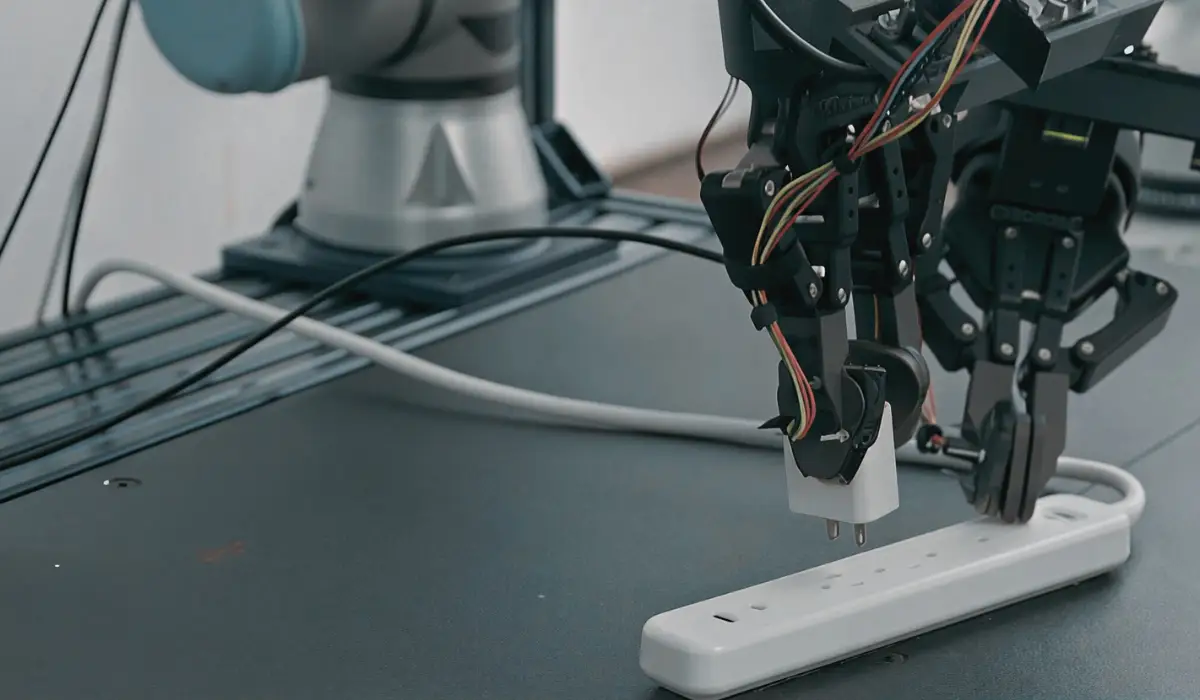
Once a command is given, the robot actively decides how to execute the task using both arms, continuously adjusting its grip, positioning, and motion as the situation evolves.
To showcase this ability, Microsoft researchers demonstrated the system using the BusyBox, a hands-on robotics benchmark built to test real-time manipulation of switches, sliders, buttons, and dials.
What truly sets the Rho-alpha Robotics Model apart, however, is its ability to go beyond vision and language by incorporating tactile sensing into its decision-making process.
As a result, robots can feel what they are touching, apply the appropriate amount of pressure, detect contact accurately, and quickly adapt their movements when tasks don’t unfold exactly as expected.
Built to adapt, not just follow scripts
Microsoft Research leaders emphasize that adaptability is the real breakthrough here. Real environments change constantly, and robots that can’t adjust tend to fail outside the lab. Rho-alpha is being developed to learn while it’s being used, improving based on feedback from human operators.
If a robot makes a mistake, a person can step in using intuitive tools like a 3D mouse to guide it back on track. Over time, the system learns from those corrections, making future interactions smoother and more reliable.
Training robots when real data is hard to get
One of the biggest challenges in robotics is data availability. Collecting large volumes of real-world training data is costly and often impractical. This is especially true for data involving touch and physical interaction.
To address this, Microsoft combines real robot demonstrations with high-quality simulated experiences. Using NVIDIA Isaac Sim on Azure, researchers generate realistic synthetic training data through reinforcement learning. These simulated tasks are then merged with physical robot data. As a result, Rho-alpha gains broader experience before interacting with real objects.
This collaboration also involves NVIDIA, helping ensure the simulations are physically accurate enough to transfer smoothly into the real world.
What’s next for Rho-alpha?
The Rho-alpha Robotics Model is currently being tested on dual-arm robots and humanoid systems, with Microsoft refining its training pipeline to improve speed, efficiency, and reliability. Organizations interested in experimenting with the model can apply for Microsoft’s Research Early Access Program, while wider availability through Microsoft Foundry is planned for the future.
As generative AI reshaped how machines understand language and images, Microsoft sees Physical AI and systems like Rho-alpha as the next major shift. The goal is simple but ambitious: robots that work alongside people, adapt to real situations, and earn trust by being genuinely useful in everyday environments.
